Challenges and complexities in Northern food systems
Mapping food access and decision-making in Nunavik
DOI:
https://doi.org/10.5304/jafscd.2026.154.004
Keywords:
Nunavik, Arctic food security, co-production of knowledge, participatory methods, food system mapping, Inuit food systemsAbstract
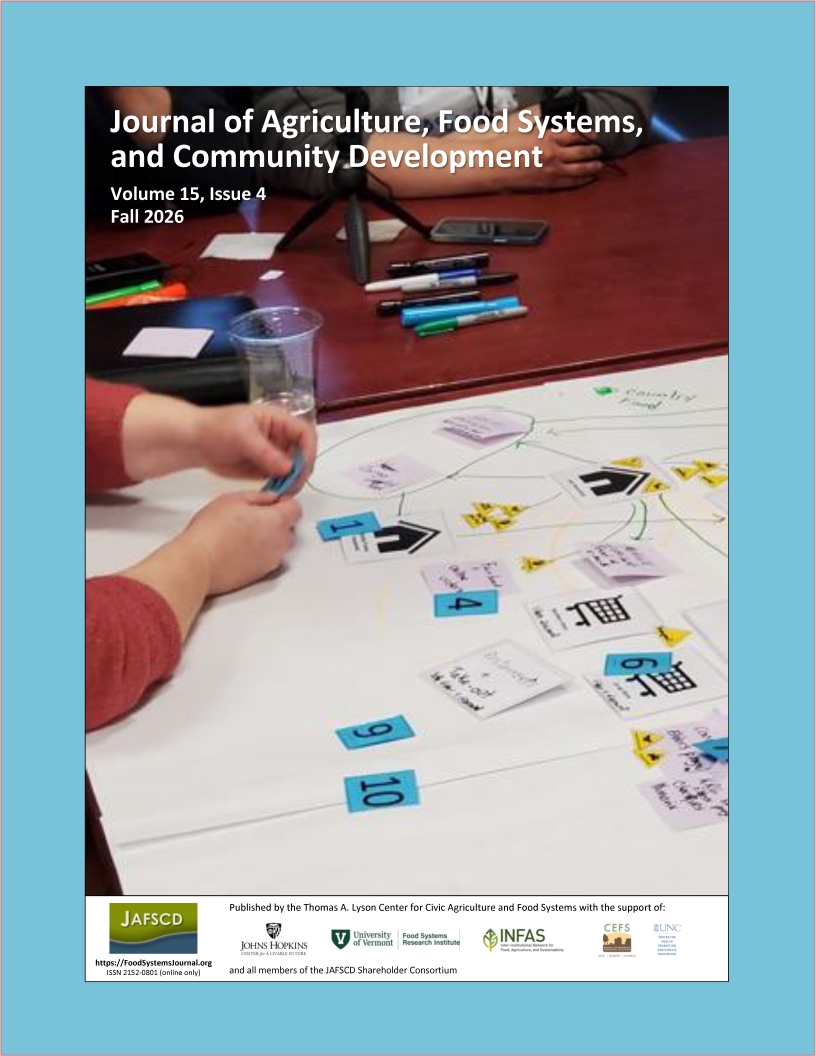
The Canadian Arctic and sub-Arctic are undergoing rapid ecological, social, and political transformations that profoundly affect local food systems. This study examines how households in Nunavik, Canada, navigate their complex, mixed subsistence and market-based food systems and identifies the factors shaping decision-making when selecting food sources. Specifically, this study asks: (1) What are the primary food acquisition sources for households, how are they accessed, and what challenges are faced? and (2) What key factors influence household decision-making in selecting food acquisition sources? Using a co-production of knowledge approach, participatory workshops were conducted with 17 community members from five Nunavik communities. Data included co-created conceptual food system maps, participant-placed preference cards, and facilitator notes from scenario-based discussions. Findings were subsequently validated in a follow-up community engagement session. Thematic qualitative analysis revealed that Nunavimmiut households draw on over 13 distinct food acquisition sources, ranging from direct harvesting and community freezers to grocery stores, family and friends, and increasingly, social media platforms that facilitate both sharing and informal markets. High costs of food and fuel, transportation barriers, time constraints, and other social factors emerged as persistent challenges. Income level and the presence of a skilled hunter strongly influenced decision strategies: low-income households without hunters relied heavily on community freezers and kin networks, while higher-income households accessed additional options such as buying country food from Inuit harvesters and southern grocery stores. These results underscore the adaptive capacity of Nunavik’s food systems alongside their sensitivity to economic and environmental disruptions. Further, these results point to the importance of addressing both structural barriers and digital access. Policies that enhance community freezers, transportation, food assistance programs, and culturally grounded digital tools can strengthen food security and resilience. This study highlights the value of interdisciplinary, community-based approaches that integrate cultural preferences, economic dimensions, and social networks in supporting Arctic food systems under conditions of rapid change.
Metrics
Downloads
Published
How to Cite
Issue
Section
License
Copyright (c) 2026 Samantha Farquhar, Sonagnon Olivier Tokpanou, Frédéric Maps, Tiff-Annie Kenny, Marianne Falardeau, Duncan Warltier, Eric Wade, Rebbeca Asch, Martin Cenek, Jon Kirchoff, Nadine Heck

This work is licensed under a Creative Commons Attribution 4.0 International License.
The copyright to all content published in JAFSCD belongs to the author(s). It is licensed as CC BY 4.0. This license determines how you may reprint, copy, distribute, or otherwise share JAFSCD content.