JAFSCD Partners

The Journal of Agriculture, Food Systems, and Community Development is pleased to have the support of leading North American university programs focused on food systems, who underwrite JAFSCD on a continuing basis: the Food Systems Research Institute at the University of Vermont, the Johns Hopkins Center for a Livable Future, the Inter-institutional Network for Food, Agriculture and Sustainability (INFAS), and, in a joint partnership, the Center for Environmental Farming Systems and the Center for Health Promotion and Disease Prevention at the University of North Carolina, Chapel Hill.


The University of Vermont

Food Systems Research Institute (FSRI) at the University of Vermont (UVM)

Burlington, Vermont, USA

The University of Vermont (UVM) is a public land-grant university with a longstanding commitment to teaching and learning about food systems through academic programs, applied research, and community education and collaboration. UVM became the first JAFSCD National Partner in 2013.

The Food Systems Research Institute (FSRI), a collaboration with the U.S. Department of Agriculture’s Agricultural Research Service (USDA ARS), focuses on improving the performance of Northeastern food systems in terms of productivity, economic viability, environmental sustainability, nutritional value, and quality of life. The FSRI gives researchers the freedom, resources, and time to engage community stakeholders, including decision-makers, farmers, and food systems actors, about issues and opportunities across our food system. This results in relevant, widely disseminated research that informs policies, practices, and programs locally and regionally for a more resilient and accessible food future for all.

UVM offers undergraduate, master’s, and doctoral degrees in Food Systems. UVM’s scale, as a land-grant university in a small state, provides students, staff, and faculty access to both diverse resources and an approachable campus community. This setting sustains relationships that integrate distinct disciplines in the natural and social sciences, as well as the humanities.

For more information, contact Dr. Polly Ericksen, Director of the Food Systems Research Institute and Research Professor in Community Development and Applied Economics, University of Vermont.

Back to top


Johns Hopkins Center for a Livable Future

Baltimore, Maryland, USA

Founded in 1996, the Johns Hopkins Center for a Livable Future (CLF) is an interdisciplinary academic center dedicated to conducting research on food security problems, educating students from all walks of life, and advocating for evidence-based reforms. Based within the Bloomberg School of Public Health, the CLF works with faculty, staff, and students throughout Johns Hopkins University to harness the expertise available in a wide range of disciplines and collaborations. The Center for a Livable Future became a JAFSCD partner in 2013.

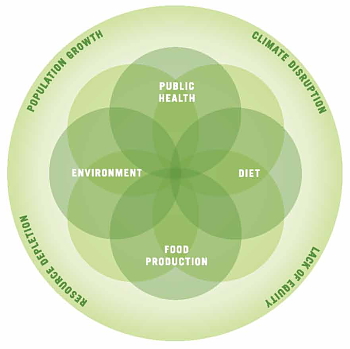
A leader in research, education, policy, and advocacy, the CLF serves as a critical resource for advocates, policymakers, educators, and students. Its core programs integrate research, education, policy, and outreach in four program areas linked to public health: food production, food communities, food system sustainability, and food system policy. The Center's work is driven by the certainty that we must understand the connections among all four program areas in order to fulfill the right to food.

The CLF explores these interrelationships — and works to improve those systems to assure food security for present and future generations. In a truly livable future, all the systems that sustain us operate synergistically and in balance to support the goals of human and ecosystem health, equity, and resilience.

For more information, contact Shawn McKenzie, associate director, Center for a Livable Future.

Back to top


INFAS logo

Inter-institutional Network for Food, Agriculture and Sustainability (INFAS)

The Inter-institutional Network for Food, Agriculture and Sustainability (INFAS) connects food system scholars, educators, and action-researcher activists across the United States. INFAS envisions a U.S. food system that is environmentally sustainable and socially just. To accomplish this, INFAS members and working groups collaborate to:

  • Increase our capacity to help build U.S. food system resilience, sustainability, and equity.
  • Raise the visibility of research-based insights into food system problems and solutions, including increasing racial equity.
  • Catalyze frontier work in food systems research, higher education, extension, and institutional change that we can achieve much better together than by working alone.
  • Diversify who is doing food systems work in academia and in action-focused research, education, and extension.

Jim Sutter admiring a gardener's squash as part of Food Dignity

INFAS was established in 2010 with a $1.5 million endowment from the W.K. Kellogg Foundation “to respond to emerging needs and opportunities to reduce human and environmental vulnerability across the food system.” The Agricultural Sustainability Institute (ASI) at University of California at Davis volunteered to host the network in perpetuity. INFAS became a JAFSCD partner in 2022.

INFAS is led by an executive committee of faculty serving at institutions across the U.S. and operates primarily through working groups in food system research, education, extension, justice and organizational development. INFAS members are eligible to join working groups, as well as engage with INFAS fellowship/mentorship program partnerships and participate in INFAS professional development and networking opportunities.

For more information, contact Ben Cousineau, INFAS coordinator. 

Photo: Jim Sutter admiring a gardener's squash as part of the Food Dignity project.

Back to top


Shared partnership:

CEFS logo

Center for Environmental Farming Systems 

Raleigh, North Carolina, USA

The Center for Environmental Farming Systems (CEFS) is a joint venture between NC State, N.C. A&T State University and the N.C. Department of Agriculture and Consumer Services. Recognized as a national and international leader in the local foods movement, and celebrated for its comprehensive efforts in facilitating a vibrant local food economy, CEFS is one of the nation’s most important centers for research, Extension and education in sustainable agriculture and community-based food systems. CEFS became a JAFSCD partner in 2017.

CEFS extends knowledge from its world-class faculty to farmers, families, and citizens across the state and beyond. CEFS doesn’t just conduct groundbreaking research; it delivers solutions directly into the hands of North Carolinians, translating campus discoveries into community solutions that help keep North Carolina agriculture growing and sustainable. 

Dr. Michelle Schroeder-Moreno, CEFS Director and W.K. Kellogg Endowed Distinguished Chair in Sustainable Community-Based Food Systems, NC State University, and Dr. Dara Bloom, CEFS Assistant Director of Community Based Food Systems and Associate Professor and Local Foods Extension Specialist, NC State University, are representing CEFS in the partnership with JAFSCD.


UNC CHPDP

UNC Center for Health Promotion and Disease Prevention

Chapel Hill, North Carolina, USA

The Center for Health Promotion and Disease Prevention (HPDP) at the University of North Carolina at Chapel Hill addresses pressing health problems by collaborating with communities to conduct research, provide training, and translate research findings into policy and practice. The Center seeks to reduce health disparities through an emphasis on community-based participatory research to ensure that the community is involved in every stage of research. The CDC selected HPDP to be one of its first three Prevention Research Centers in 1985. Now composed of 26 academic institutions, the PRC program is an interdependent network of community, academic, and public health partners that conduct prevention research and promote practices proven to promote good health.

The vision of HPDP is to work in partnership to bring public health research findings to the daily lives of individuals and their communities with a special focus on North Carolina and populations vulnerable to disease. HPDP became a JAFSCD partner in 2021.

For more information, contact Dr. Alice Ammerman, Director, Center for Health Promotion and Disease Prevention, University of North Carolina at Chapel Hill.

Back to top


FORMER PARTNERS

We acknowledge the contribution of our former partner, the Institute for Sustainable Food Systems at Kwantlen Polytechnic University, for its commitment from 2013 to 2025. 

We also acknowledge the contribution of our Founding Partner, the Leopold Center for Sustainable Agriculture at Iowa State University, for its three-year commitment from 2013 to 2016. 

Back to top